
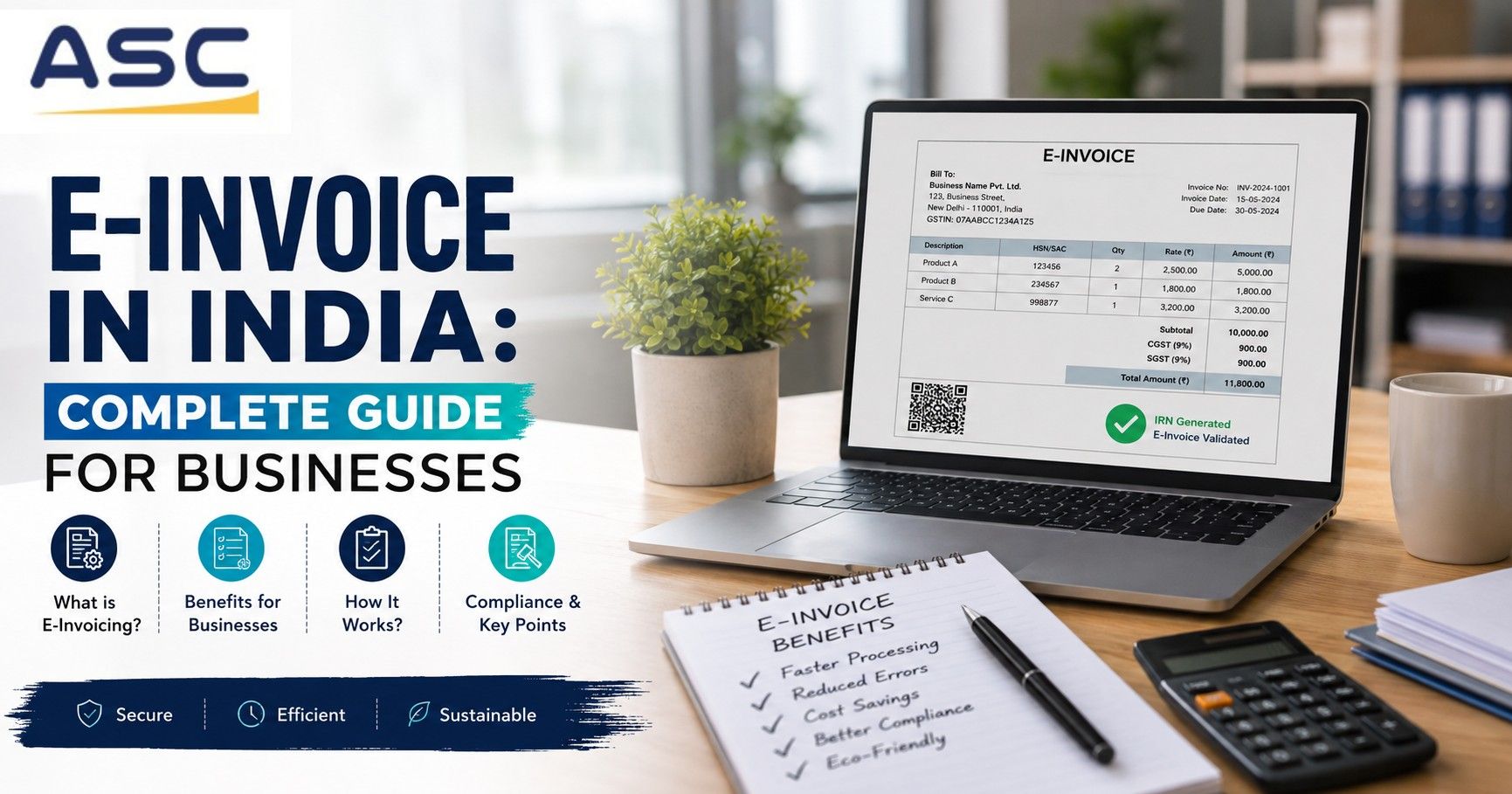
E-Invoice has become an important part of GST compliance for businesses in India. However, many businesses still assume that an E-Invoice simply means creating an invoice digitally. In reality, the process involves reporting applicable invoice details through an Invoice Registration Portal (IRP), generating an Invoice Reference Number (IRN), and following the prescribed GST compliance process.
For businesses handling large volumes of transactions, the challenge is not limited to generating an E-Invoice. They also need to manage accurate invoice data, timely reporting, IRN generation, cancellations, corrections, GSTR-1 reconciliation, and e-way bill requirements. This complete guide explains how E-Invoice works in India, who needs to comply, and how businesses can improve their compliance workflows through automation.
What Is an E-Invoice?
An E-Invoice, or electronic invoice under the GST system, is not simply a PDF invoice sent by email. It is a standardized GST invoice reporting mechanism in which applicable invoice details are submitted through an authorized Invoice Registration Portal.
Once the information is successfully validated, the system generates an Invoice Reference Number (IRN). The process also provides authenticated invoice information and a QR code containing relevant details.
In simple terms, the business creates the invoice using its ERP, accounting software, or billing system. The invoice data is then reported through the applicable IRP mechanism for validation and IRN generation.
This helps create a more standardized and digitally connected invoicing process.
Why Was E-Invoicing Introduced in India?
The introduction of E-Invoice was intended to improve the efficiency and standardization of GST invoice reporting.
The system supports several important objectives, including:
• Standardization of invoice data across businesses.
• Improved digital reporting of applicable transactions.
• Reduction in duplicate and incorrect invoice reporting.
• Better visibility into invoice information.
• Improved reconciliation between business records and GST reporting.
• Integration with connected compliance processes such as e-way bill generation, where applicable.
• Reduced dependence on repetitive manual data entry.
For businesses, E-Invoice can also create an opportunity to move from disconnected manual processes toward more integrated compliance workflows.
How Does the E-Invoice Process Work?
The E-Invoice process generally follows a structured workflow.
First, a business creates an invoice using its existing ERP, accounting software, or billing system. The relevant invoice data is then prepared according to the prescribed format and submitted through the applicable Invoice Registration Portal.
The system validates the information. Once the invoice is successfully accepted, an IRN is generated and the authenticated invoice information, including the relevant QR code, is returned.
A simplified workflow looks like this:
Business or ERP → Invoice Creation → Data Validation → Invoice Registration Portal → IRN Generation → QR Code → GST Reporting Workflow → E-Way Bill Workflow, Where Applicable
The accuracy of source data is extremely important. Incorrect GSTIN details, HSN information, tax calculations, document numbers, or invoice values can create validation errors and operational delays.
Who Needs to Generate an E-Invoice in India?
E-Invoice applicability depends on several factors, including the taxpayer's Aggregate Annual Turnover, the nature of the transaction, and whether the taxpayer belongs to an exempt category.
The general E-Invoice applicability threshold is ₹5 crore Aggregate Annual Turnover (AATO) under the notified framework.
However, businesses should not assume that turnover is the only factor. They should also review:
• Whether they are registered under GST.
• Whether their Aggregate Annual Turnover meets the applicable threshold.
• Whether the transaction or document falls within the E-Invoice framework.
• Whether they belong to a category specifically exempt from E-Invoice requirements.
• Whether any new GST notification or advisory affects their compliance obligations.
A proper applicability review is important because E-Invoice compliance should be based on the taxpayer's actual business and regulatory position.
E-Invoice Turnover Limit
The E-Invoice turnover limit is one of the most frequently searched aspects of E-Invoice compliance.
The current general threshold is ₹5 crore AATO under the applicable notified framework. Aggregate Annual Turnover is calculated at the PAN level and may involve turnover across registrations associated with the same PAN.
Businesses should also understand that crossing the threshold is not always the only compliance consideration. The transaction type and applicable exemptions must also be reviewed.
Another important operational requirement applies to taxpayers with a higher turnover. From 1 April 2025, taxpayers with an Aggregate Annual Turnover of ₹10 crore or more are required to report applicable invoices, credit notes, and debit notes within the prescribed 30-day reporting window from the document date.
Businesses with high transaction volumes should therefore avoid leaving E-Invoice generation until the end of the month.
How to Generate an E-Invoice
The E-Invoice generation process should ideally begin with accurate invoice preparation.
A practical process includes the following steps:
• Create the invoice in your ERP, accounting, or billing system.
• Verify the supplier and recipient GSTIN details.
• Validate the HSN and applicable tax details.
• Check the invoice number, invoice date, taxable value, and transaction information.
• Prepare the invoice data in the required format.
• Submit the data through an authorized IRP or integrated API mechanism.
• Allow the system to validate the submitted information.
• Receive the IRN after successful processing.
• Retain the QR code and authenticated invoice information.
• Complete downstream GST, accounting, reconciliation, and e-way bill processes where applicable.
For businesses processing hundreds or thousands of invoices, manual generation can increase the risk of delays and data-entry errors. This is where E-Invoice automation becomes valuable.
What Is an Invoice Reference Number or IRN?
The Invoice Reference Number (IRN) is a unique reference generated after the applicable invoice information is successfully reported and processed through the Invoice Registration Portal.
The IRN plays an important role in the E-Invoice ecosystem because it confirms that the relevant invoice data has been processed through the prescribed mechanism.
The basic flow is:
Invoice → IRP Submission → Validation → IRN Generation
Businesses should distinguish between their internal invoice number and the IRN. The invoice number is generated as part of the business's invoicing process, while the IRN is generated through the E-Invoice reporting process.
What Is the E-Invoice QR Code?
The E-Invoice QR code contains important information associated with the reported invoice.
Depending on the applicable system requirements, the QR code can contain details such as:
• Supplier GSTIN.
• Recipient GSTIN.
• Invoice number.
• Invoice date.
• Invoice value.
• Number of line items.
• HSN-related information.
• IRN.
• IRN generation details.
The QR code supports invoice verification and helps create a more standardized digital compliance record.
E-Invoice vs Normal Tax Invoice
A normal tax invoice is created by a business in accordance with applicable GST invoicing requirements. An E-Invoice is different because eligible taxpayers are required to report applicable invoice information through the prescribed E-Invoice mechanism.
A business that falls within the E-Invoice framework cannot treat the process as simply issuing a standard invoice and storing it internally. Applicable invoice information must follow the required IRP reporting process.
The main difference is therefore the additional registration and authentication workflow associated with E-Invoice compliance, including IRN generation and the applicable QR code.
E-Invoice vs E-Way Bill
E-Invoice and E-Way Bill serve different purposes.
An E-Invoice primarily relates to the reporting and authentication of applicable invoice information. An E-Way Bill relates to the movement of goods when e-way bill requirements apply.
Although these systems can be connected, businesses should not assume that every E-Invoice automatically results in an E-Way Bill.
The requirement for an E-Way Bill depends on the nature of goods movement and other applicable conditions. Businesses must ensure that both compliance processes are reviewed separately.
Internal Link Opportunity: E-Way Bill in India: Complete Guide for Businesses
E-Invoice and GSTR-1
E-Invoice can improve the flow of invoice information into the GST reporting ecosystem. Relevant invoice details may be auto-populated into applicable GSTR-1 tables.
However, businesses should not depend entirely on auto-population.
Before filing GSTR-1, businesses should:
• Reconcile E-Invoice records with their accounting system.
• Review cancelled invoices.
• Check taxable values and tax amounts.
• Identify data mismatches.
• Verify whether all relevant transactions have been correctly reported.
• Complete any necessary reconciliation before filing.
A strong reconciliation process can help businesses identify data issues before they become larger compliance problems.
E-Invoice Cancellation and Amendment
An E-Invoice cannot simply be edited through the IRP after successful IRN generation.
Where cancellation is permitted, businesses must act within the applicable cancellation period. The current E-Invoice framework generally allows cancellation within 24 hours from IRN generation, subject to applicable conditions.
If an E-Way Bill has already been generated and remains active, the related compliance steps may also need to be considered before cancellation.
For errors identified after the cancellation window, businesses may need to use an appropriate corrective process depending on the nature of the transaction, GST requirements, and accounting treatment.
Common E-Invoice Errors Businesses Should Avoid
Many E-Invoice errors originate from incorrect source data rather than the E-Invoice portal itself.
Common issues include:
• Incorrect supplier or recipient GSTIN.
• Duplicate invoice or document numbers.
• Incorrect HSN details.
• Mismatched taxable values.
• Incorrect tax calculations.
• Inconsistent ERP master data.
• API integration failures.
• Incorrect invoice dates.
• Missing mandatory information.
Businesses can reduce these problems by validating data before submitting it for IRN generation.
E-Invoice Automation for Businesses
Manual E-Invoice processing may work for businesses with a small number of invoices. However, as transaction volumes increase, manual processes can become time-consuming and difficult to control.
A traditional workflow may involve creating an invoice, manually entering data, submitting it to the portal, waiting for validation, downloading the result, and storing the information.
An automated E-Invoice workflow can connect these processes more efficiently.
For example:
ERP or Billing System → Data Extraction → Automated Validation → API Integration → IRN Generation → Invoice Processing → E-Way Bill Workflow → Document Management
This approach can help businesses reduce repetitive manual work and improve operational consistency.
How AI Can Improve E-Invoice Workflows
AI and automation can support businesses by improving repetitive invoice and document processes.
Potential applications include:
• Invoice data extraction.
• OCR-based document processing.
• Automated field validation.
• Duplicate invoice detection.
• GSTIN verification.
• HSN assistance.
• Exception identification.
• Reconciliation support.
• Document classification.
• Automated workflow routing.
However, businesses should remember that AI does not guarantee GST compliance. Technology can assist with validation and automation, but the statutory responsibility for compliance remains with the taxpayer.
This is where ASC Global.AI can support businesses looking to improve their E-Invoice and tax-document workflows through automation, integration, and intelligent process management.
E-Invoice Compliance Checklist
Before generating an E-Invoice, businesses should verify:
• GSTIN details.
• Invoice number.
• Invoice date.
• HSN details.
• Tax rate.
• Taxable value.
• Customer information.
• Place of supply.
• Transaction type.
After successful generation, businesses should ensure:
IRN has been received.
QR code information is retained.
Invoice records are stored correctly.
E-Way Bill requirements are reviewed where applicable.
ERP records are updated.
GSTR-1 reconciliation is completed.
Cancellation and correction procedures are documented.
Latest E-Invoice Rules for Businesses in 2026
Businesses should regularly monitor GSTN and authorized IRP updates because E-Invoice procedures, validations, and reporting requirements can change.
The key compliance points businesses should currently monitor include:
• The applicable ₹5 crore Aggregate Annual Turnover threshold.
• The 30-day reporting restriction for taxpayers with AATO of ₹10 crore or more.
• The applicable cancellation window.
• Changes in IRP validation requirements.
• Updates affecting GSTIN, HSN, invoice data, or API integration.
• Changes in connected GSTR-1 and e-way bill workflows.
For compliance purposes, businesses should always verify the latest official notification, advisory, or portal guidance before implementing process changes.
Frequently Asked Questions About E-Invoice
1. What is an E-Invoice?
An E-Invoice is an electronic GST invoice reporting mechanism in which applicable invoice information is submitted through an authorized Invoice Registration Portal for validation and IRN generation.
2. Who needs to generate an E-Invoice?
GST-registered businesses meeting the applicable turnover threshold and transaction requirements may need to generate E-Invoices, subject to notified exemptions.
3. What is the E-Invoice limit?
The general E-Invoice applicability threshold is ₹5 crore Aggregate Annual Turnover under the applicable notified framework.
4. What is an IRN?
IRN stands for Invoice Reference Number. It is generated after successful processing of applicable invoice information through the E-Invoice system.
5. Can an E-Invoice be cancelled?
Yes, cancellation may be possible within the applicable cancellation period and subject to relevant conditions.
6. Can an E-Invoice be amended?
Direct amendment through the IRP is generally not available after successful generation. The appropriate correction process depends on the circumstances.
7. Is E-Invoice required for B2C transactions?
Businesses should distinguish between E-Invoice applicability and other GST invoicing or QR code requirements applicable to B2C transactions.
8. Does E-Invoice automatically generate an E-Way Bill?
Not in every situation. E-Way Bill requirements depend on the transaction and applicable conditions.
9. Can E-Invoice generation be automated?
Yes. Businesses can use ERP integration, APIs, automated validation, and workflow systems to improve E-Invoice generation and management.
Conclusion
E-Invoice is an important part of the digital GST compliance ecosystem in India. For eligible businesses, compliance involves much more than simply generating an invoice or obtaining an IRN.
A reliable E-Invoice process requires accurate source data, timely reporting, proper cancellation controls, reconciliation, GSTR-1 review, and coordination with e-way bill requirements where applicable.
As businesses grow, manual compliance processes can become increasingly difficult to manage. Automation, ERP integration, APIs, and intelligent document workflows can help create a more efficient and scalable system.
ASC Global.AI can help businesses explore smarter E-Invoice and tax automation workflows by supporting process integration, data validation, automation, and document management. The objective is not simply to automate invoices, but to help businesses build a more connected and efficient compliance workflow.