
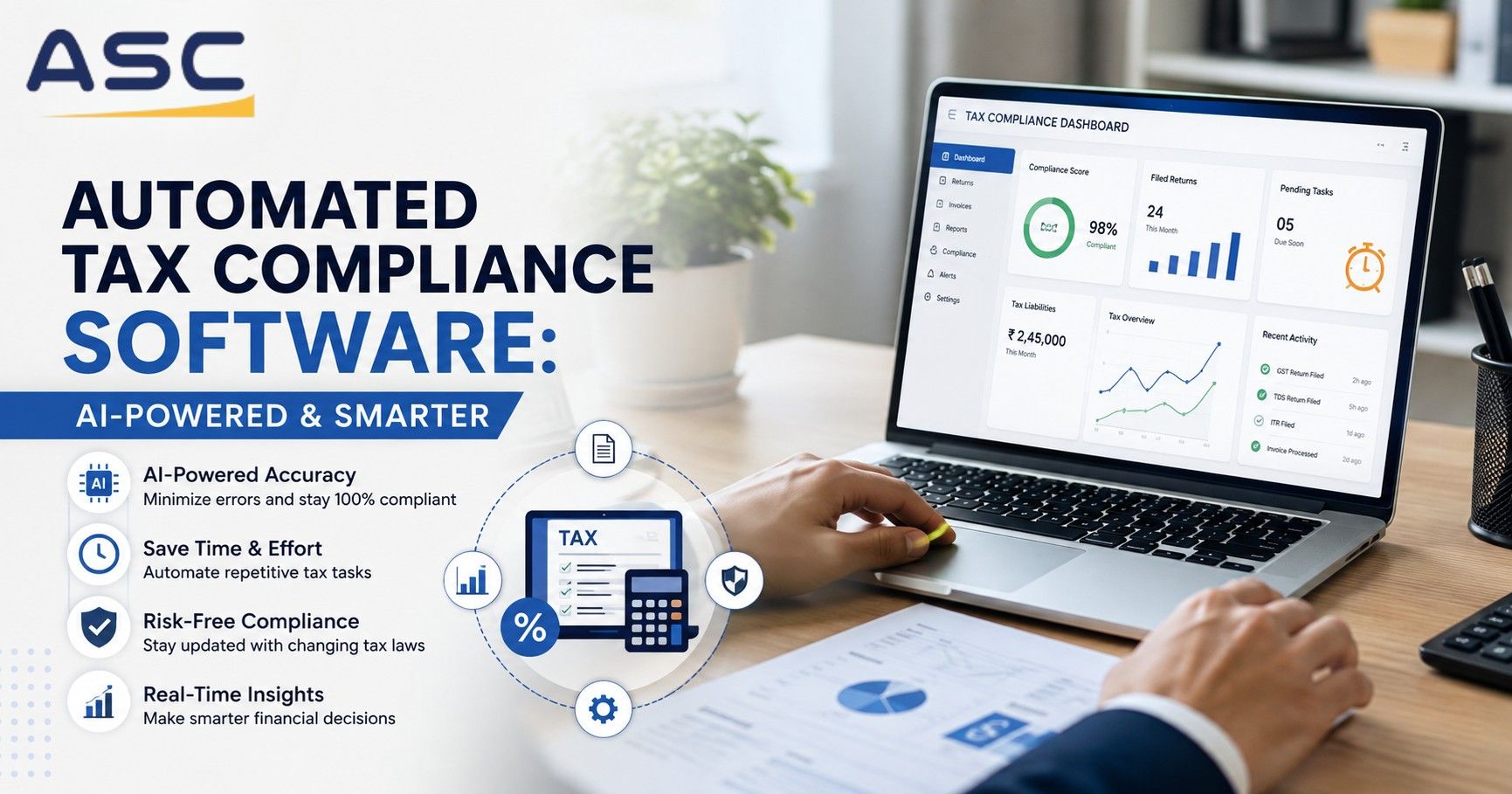
Tax compliance in India is becoming increasingly data-driven. Businesses must manage GST returns, reconciliation, e-invoicing, e-way bills, TDS, documentation, deadlines and audit trails while maintaining accurate financial records. For companies handling multiple entities, GSTINs or high transaction volumes, spreadsheet-heavy processes can quickly become difficult to control.
This is where automated AI tax compliance software India solutions can make a practical difference. Instead of treating compliance as a collection of disconnected filing activities, businesses can build structured workflows for data extraction, validation, reconciliation, exception management, review and filing. The objective is not to replace tax professionals, but to reduce repetitive work and give finance and tax teams better visibility.
What Is Automated Tax Compliance Software?
Automated tax compliance software is technology designed to manage repetitive tax-related processes through predefined rules, integrations and workflow automation.
A modern platform can connect business data with tax workflows for activities such as:
• Data collection and extraction
• Tax validation
• GST return preparation
• Reconciliation
• E-invoice workflows
• E-way bill processes
• Exception identification
• Filing preparation
• Compliance monitoring
• Audit-trail management
An AI tax compliance software layer can further assist with document understanding, anomaly detection, classification and workflow prioritisation.
The practical difference is important: automation handles repetitive processing, while qualified professionals continue to review complex matters and exercise professional judgment.
Why Are Businesses Moving Toward Tax Compliance Automation?
Manual compliance becomes increasingly difficult as transaction volumes and regulatory touchpoints increase.
Common challenges include:
1. Multiple government portals and systems
2. Repetitive data entry
3. Large transaction volumes
4. Invoice and return mismatches
5. Manual reconciliation
6. Changing compliance requirements
7. Missed deadlines
8. Fragmented compliance data
9. ERP-to-tax-system disconnects
10. Limited audit visibility
An ai tax platform can address these challenges by bringing data, rules, workflows, alerts and reporting into a more centralized operating environment.
The goal should not be “automation at any cost.” The better objective is controlled automation with human oversight.
What Does an AI Tax Compliance Platform Actually Do?
A typical workflow can look like this:
Business Data → ERP/Accounting System → Data Extraction → AI Validation → Tax Rules → Reconciliation → Exception Detection → Return Preparation → Human Review → Filing → Compliance Dashboard
This workflow allows businesses to move away from isolated spreadsheets and repetitive manual checks.
For example, an automated workflow can identify missing information before a return is prepared, flag mismatches requiring investigation and route exceptions to the appropriate team member.
AI Tax Compliance Software vs Traditional Tax Software
Traditional Tax Software vs AI-Powered Tax Platform
Instead of using a table, you can present the comparison as clear bullet points:
• Workflows: Traditional tax software generally relies on rule-based workflows, whereas an AI-powered tax platform can combine AI-assisted capabilities with rule-based workflows.
• Data Handling: Traditional systems may require more manual data handling, while AI-powered platforms can support automated or assisted data extraction.
• Validation: Traditional software typically performs basic validation based on configured rules, whereas AI-powered platforms can provide more intelligent validation and identify potential exceptions for review.
• Reconciliation: Traditional processes may involve greater manual reconciliation, while AI-powered platforms can automate or assist with reconciliation across relevant datasets.
• Alerts: Traditional software may rely primarily on reactive reminders, whereas an AI-powered platform can support proactive workflow alerts and exception notifications.
• Reporting: Traditional systems may provide standard or static reports, while AI-powered platforms can offer more data-driven insights based on available information.
• Human Involvement: Traditional workflows can be more human-intensive, while AI-powered platforms aim to combine automation with human review and professional oversight.
AI should augment tax professionals, not replace statutory accountability or professional judgment.
Key Features of Automated Tax Compliance Software
Automated GST Compliance
A suitable platform may support workflows around GST return preparation, validation and filing, depending on the actual product capabilities.
Common workflows include:
• GSTR-1
• GSTR-3B
• Applicable GST returns
• Data validation
• Filing preparation
• Reconciliation
Businesses should always verify the exact forms and services supported by their chosen platform.
Automated Tax Filing
Automated tax filing software can organize the process into:
Data Collection → Validation → Return Preparation → Approval → Filing → Confirmation → Record Keeping
This reduces the need to repeatedly move information between spreadsheets, accounting systems and compliance workflows.
GST Reconciliation
Reconciliation is particularly important where businesses need to compare purchase records with GST data.
A technology-assisted process can help organize:
• Purchase registers
• GST return data
• ITC-related records
• Mismatch identification
• Exception handling
Automation does not eliminate the need to investigate differences; it helps teams identify where investigation is required.
E-Invoice Automation
The e-invoicing workflow can be represented as:
ERP → Invoice → IRP → IRN → QR Code
The official GST e-invoice system explains that invoice information reported through the IRP can flow into the GST system, supporting GSTR-1 auto-population and integration with the e-way bill ecosystem.
The applicability of e-invoicing must, however, be determined based on the taxpayer's circumstances and applicable notifications rather than assumed from software availability. The official IRP information records the progressive expansion of the mandate based on turnover thresholds.
E-Way Bill Automation
Where supported, technology can help businesses manage:
• E-way bill generation
• ERP integration
• Document matching
• Status monitoring
• Vehicle-related updates
• Workflow tracking
Because e-invoice and e-way bill systems are interconnected, integrating the relevant processes can reduce duplicate data entry.
AI-Based Document Extraction
AI-assisted document processing can potentially support:
• OCR
• Invoice extraction
• Document classification
• Field extraction
• Data validation
Actual capabilities should always be confirmed against the software's documented features.
AI-Based Error Detection
AI can assist in identifying potential exceptions such as:
• Duplicate invoices
• Missing fields
• Unusual values
• Data mismatches
• Inconsistent GSTIN information
• Potential compliance exceptions
These should be treated as review signals, not automatically as legal conclusions.
What Taxes Can Be Managed Through Automated Compliance Software?
The answer depends on the platform's actual capabilities. Potential workflows may include:
• GST returns
• E-invoicing
• E-way bills
• ITC reconciliation
• TDS-related workflows
• Income-tax data preparation
• Documentation and compliance tracking
• Corporate tax workflows
Tax technology should not be presented as handling a particular tax merely because the platform uses AI. Businesses should confirm the precise scope before implementation.
AI Tax Compliance Software for Indian Businesses
India presents specific requirements that make localized tax technology particularly valuable.
Businesses may need to coordinate:
• GST registrations and GSTINs
• GST returns
• E-invoicing
• E-way bills
• TDS processes
• Multiple entities
• ERP integrations
• Changing regulatory requirements
• Reconciliation and audit documentation
Consequently, ai tax compliance software India solutions should be evaluated for their ability to work with Indian tax workflows rather than simply their general AI capabilities.
Who Should Use an AI Tax Compliance Platform?
An ai tax platform can be relevant for:
• SMEs
• Large enterprises
• CFOs
• Finance teams
• Tax teams
• Accounting departments
• CA firms
• Tax consultants
• Multi-GSTIN businesses
• E-commerce businesses
• Manufacturers
• Service businesses
The value generally increases when businesses have high transaction volumes, multiple entities or significant reconciliation requirements.
Benefits of Automated Tax Compliance Software
A well-designed implementation can provide:
1. Reduced repetitive manual work
2. Faster compliance workflows
3. Improved data consistency
4. Structured reconciliation
5. Deadline monitoring
6. Better audit trails
7. Centralized compliance visibility
8. Greater scalability
9. ERP/API integration
10. Improved exception management
These are operational benefits—not guarantees of zero errors or zero compliance risk.
Automated Tax Filing Software: How Does It Work?
A practical implementation can follow ten stages:
1. Data Collection – Gather accounting, invoice and transaction data.
2. Data Extraction – Extract relevant fields from connected systems or documents.
3. Validation – Check data against defined tax and business rules.
4. Classification – Categorize transactions for the applicable workflow.
5. Reconciliation – Compare relevant records and identify differences.
6. Exception Detection – Flag transactions requiring attention.
7. Review & Approval – Route exceptions and returns for human review.
8. Filing – Submit through the appropriate authorized process.
9. Confirmation – Capture filing or submission status.
10. Audit Trail – Maintain records of actions and approvals.
This creates a repeatable compliance operating model rather than a one-time filing process.
How AI Improves Tax Compliance
AI can strengthen tax workflows through:
• AI + OCR for document processing
• AI + data validation
• AI + reconciliation
• AI + anomaly detection
• AI + workflow prioritization
• AI + regulatory knowledge
• AI + workflow automation
• AI + human review
The strongest approach is not “AI instead of experts.” It is AI + automation + human expertise.
Can AI Replace Tax Professionals?
No—not where professional judgment, interpretation or statutory responsibility is involved.
AI can help:
• Process information
• Classify data
• Detect patterns
• Compare records
• Flag exceptions
• Automate repetitive tasks
• Summarize information
Tax professionals can:
• Interpret applicable law
• Advise businesses
• Review complex transactions
• Resolve exceptions
• Handle notices
• Support litigation matters
• Make professional judgments
This human-and-technology model is more realistic and trustworthy than claiming that AI replaces CAs or tax professionals.
How Secure Is AI Tax Compliance Software?
Tax platforms may process sensitive financial and business information. Security evaluation should therefore cover:
• Encryption
• Authentication
• Role-based access
• Access controls
• Audit logs
• Data retention
• Backups
• Secure APIs
• Privacy controls
• Compliance processes
Businesses should ask vendors for their actual security architecture and certifications where applicable. Claims such as “100% secure” should not be accepted without substantiation.
AI Tax Platform: ERP and API Integration
A connected architecture can look like:
SAP / Oracle / Tally / Dynamics / Custom ERP / Accounting Software
↓
API Layer
↓
AI Tax Platform
↓
GST / Tax Workflow
However, businesses should verify exactly which ERP and API integrations are supported before selecting a platform.
Useful integration capabilities may include:
• Tax APIs
• GST APIs
• E-invoice APIs
• Compliance APIs
• Data validation APIs
This can help create a continuous flow between operational systems and tax workflows.
Automated Tax Compliance for Multi-GSTIN Businesses
Multi-GSTIN organizations have additional complexity because compliance information can be distributed across entities and registrations.
A centralized solution can potentially provide:
• Entity-level compliance
• GSTIN-level visibility
• Centralized dashboards
• Role-based access
• Consolidated reporting
• Exception tracking
• Deadline monitoring
This is especially valuable for groups managing compliance across multiple locations.
How to Choose an AI Tax Compliance Platform
Before purchasing, evaluate:
• Tax coverage
• GST capabilities
• E-invoice support
• E-way bill workflows
• TDS capabilities
• Reconciliation
• AI functionality
• ERP integration
• API availability
• Security controls
• Audit trails
• Scalability
• Human expert support
• Regulatory update mechanism
• Customer support
The right ai tax compliance software should fit the organization's actual compliance model—not simply have the largest feature list.
Automated Tax Compliance Software vs Tax Consultant
Instead of using a table, you can present the comparison in a more natural bullet-point format:
• Repetitive Work: Automated tax compliance software can automate repetitive compliance workflows, while a tax professional provides the judgment required to review and manage those activities.
• Data Processing: Software can process structured tax and financial data efficiently, whereas tax professionals interpret the information in the context of applicable tax requirements.
• Anomaly Detection: Automated systems can identify potential mismatches, inconsistencies or anomalies for further review, while tax professionals investigate and resolve complex issues.
• Deadline Management: Software can help track compliance deadlines and provide workflow alerts, while tax professionals advise businesses on compliance priorities and strategy.
• Reporting: Software can generate compliance reports and provide organized information, while tax professionals use that information to advise the business and make informed compliance decisions.
• Notices and Representation: Software can help organize relevant compliance records, but tax professionals handle complex tax notices, representations and other matters requiring professional expertise.
The strongest model is therefore:
AI + Automation + Human Expertise
ASC Global.AI — AI-Powered Tax Compliance Automation
ASC Global.AI can be positioned around a practical problem: manual, fragmented and repetitive compliance workflows.
The technology proposition should combine:
AI + Automation + Tax Workflows
with:
Tax and Compliance Expertise
and, where required:
Human Review and Professional Oversight
ASC Group's publicly described fintech capabilities include GST compliance-related activities, GST return preparation/filing, e-invoicing, e-way bill workflows, reconciliation, GST health checks and ERP/API-related integration. The supplied brief specifically identifies these capabilities as the foundation for the ASC Global.AI positioning.
Frequently Asked Questions
1. What is automated AI tax compliance software in India?
It is software that combines tax rules, workflow automation and AI-assisted capabilities to help businesses manage repetitive compliance processes such as data validation, reconciliation, return preparation and compliance monitoring.
2. Can automated tax filing software eliminate human review?
Not necessarily. Human review remains important for exceptions, complex transactions, professional judgment and statutory responsibilities.
3. Is AI tax compliance software suitable for SMEs?
Yes, particularly where an SME has growing transaction volumes, multiple GST registrations, recurring reconciliation work or limited internal compliance capacity.
4. Can AI replace a tax consultant?
No. AI can automate processing and identify potential issues, while tax professionals provide interpretation, advice, judgment and resolution of complex matters.
5. Is e-invoicing automatically included in every tax software?
No. Businesses should verify whether the selected platform supports the required e-invoice workflow and whether their organization falls within the applicable government mandate.
Official IRP guidance should be checked for current applicability.
6. What should businesses verify before adopting AI tax software?
They should evaluate tax coverage, GST capabilities, integrations, reconciliation, security, audit trails, scalability, support and the vendor's mechanism for keeping workflows aligned with regulatory changes.
Conclusion
The future of tax compliance is not simply about filing returns faster. It is about creating a connected process in which business data can move through validation, reconciliation, exception management, review and filing with greater control.
For Indian businesses, automated ai tax compliance software India solutions can become particularly valuable as transaction volumes, GST complexity, digital invoicing and integration requirements increase. The best implementations will combine automation with strong controls and professional oversight.